Announcement
Maryland Governor Wes Moore to Return to Quantum World Congress 2026
One year after using the QWC stage to announce Microsoft's arrival in Maryland, Moore returns as the state's Capital of Quantum strategy moves from ambition to buildout.
Governor Wes Moore · State of Maryland · QWC 2026
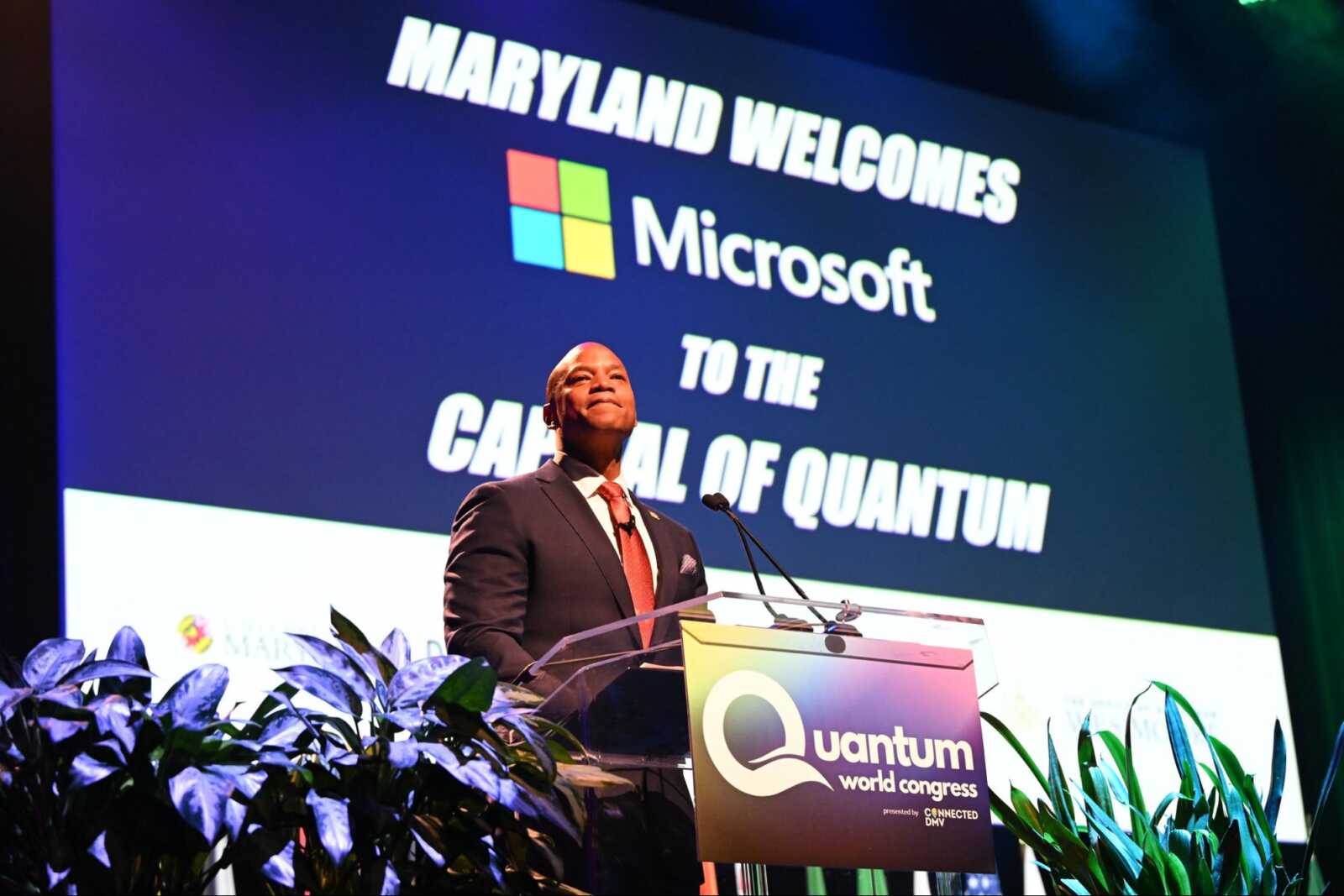
Quantum World Congress today announced that Maryland Governor Wes Moore will return to the QWC Main Stage in 2026, joining the global quantum community September 23–25 at The Hotel at the University of Maryland in College Park.
Governor Moore is currently scheduled to speak Thursday, September 24, from 11:05–11:20 a.m.
His return comes almost exactly one year after a consequential appearance at Quantum World Congress 2025 — and this time, QWC is coming to him.
Last September, Moore stood on the QWC stage in Northern Virginia and made the case that quantum technology represented not only a scientific frontier, but an economic one.
“The future of wealth creation is quantum. The future of economic prosperity is quantum.”
Then he made news. From the QWC stage, Moore announced that Microsoft would establish a new quantum research center in the University of Maryland's Discovery District, bringing one of the world's largest technology companies into an expanding College Park quantum cluster already anchored by the University of Maryland, IonQ, federal research partners and a growing network of startups and technology companies.
One year later, Quantum World Congress will convene inside that same ecosystem.
Governor Wes Moore at Quantum World Congress 2025
QWC 2026 is moving to College Park, with the University of Maryland serving as Lead Academic Partner, as Maryland continues to turn its Capital of Quantum strategy from a declaration of intent into physical infrastructure, research capacity, companies, talent and investment.
“Last year, Governor Moore didn't come to Quantum World Congress simply to talk about what might be possible. He came to make news — and to make clear that Maryland intended to compete. A year later, we are bringing the world's quantum community to College Park, where so much of that strategy is now taking physical form.”
"That is what makes his return especially meaningful. We get to move the conversation forward. What does it look like when a state makes a serious bet on an emerging industry? What happens after the announcement — when you have to build the labs, attract the companies, develop the talent, connect the research to markets and make the ecosystem work? Maryland is attempting to answer those questions in real time, and there could not be a more appropriate place for that conversation than Quantum World Congress," Thomas added.
A Year of Building
Moore launched the Capital of Quantum Initiative in January 2025 alongside University of Maryland President Darryll J. Pines and IonQ leadership, setting an ambition to catalyze more than $1 billion in public and private investment over five years and establish Maryland as one of the world's leading centers for quantum information science and technology.
The strategy builds on assets Maryland already possessed: decades of quantum research at UMD; the Joint Quantum Institute and Joint Center for Quantum Information and Computer Science; the National Quantum Laboratory; IonQ, which grew out of UMD research and is headquartered in College Park; and proximity to many of the federal agencies expected to shape the development, evaluation, security and adoption of quantum technologies.
In April 2025, Maryland and the Defense Advanced Research Projects Agency (DARPA) established the Capital Quantum Benchmarking Hub at UMD's Applied Research Laboratory for Intelligence and Security, creating a state-federal partnership connected to DARPA's effort to rigorously test whether promising approaches to quantum computing can reach utility scale. The agreement can unlock up to $100 million in federal funding over four years to match state quantum investments.
Then came Microsoft. Announced during Moore's QWC 2025 address, the company's planned Quantum Research Center in UMD's Discovery District is designed to support collaborative hardware and software development and provide a place for Microsoft engineers to work directly with researchers, government partners and the broader Maryland quantum ecosystem.
The buildout has continued in 2026. In April, Moore joined leaders at the University of Maryland for the groundbreaking of a new 110,000-square-foot, $65 million headquarters for ARLIS in the Discovery District, expanding the physical infrastructure supporting national security research and quantum technology evaluation.
That same month, the University of Maryland announced a $7.5 million expansion of its partnership with IonQ, funded through the Capital of Quantum initiative, to expand the National Quantum Laboratory, increase access to quantum computing systems and add a major new emphasis on quantum networking.
Maryland's enacted Fiscal Year 2027 budget includes tens of millions of dollars in additional quantum investments: funding toward IonQ's planned new College Park headquarters; expansion of the Quantum Startup Foundry and quantum testbeds; a new Deep Tech Facility in the Discovery District; and recruitment of specialized faculty, technical experts and quantum evaluation talent at UMD and ARLIS. The Moore administration said in April that Maryland had already secured well over $500 million in quantum investments since launching Capital of Quantum.
The result is an unusually concentrated experiment in regional technology development: using public investment to connect fundamental research, startup formation, major technology companies, federal missions, specialized infrastructure, workforce development and potential customers in one geographic ecosystem.
From the QWC Stage to College Park
For Quantum World Congress, Moore's return also marks a full-circle moment. QWC 2025 brought the global quantum ecosystem together in Tysons, Virginia. From that stage, Moore welcomed Microsoft to Maryland and laid out his case for why states and regions should treat quantum as an economic development opportunity rather than simply a research field.
In 2026, the Congress moves to The Hotel at the University of Maryland, steps from the Discovery District and the growing collection of institutions and companies at the center of Maryland's strategy. UMD will serve as the event's Lead Academic Partner, bringing QWC attendees into direct proximity to an ecosystem that includes more than 200 quantum researchers and major assets spanning fundamental science, engineering, computing, national security, entrepreneurship and commercialization.
Moore's September 24 appearance will give the global QWC audience a chance to hear what comes next — not simply for an individual project, but for a state attempting to build an enduring quantum economy.
"Quantum World Congress is about connecting research with reality," Thomas said. "This year, our host region is itself becoming a case study in how that happens."
About Governor Wes Moore
Wes Moore is the 63rd Governor of the State of Maryland. Since taking office in January 2023, Moore has made economic competitiveness, emerging industries and technology-driven growth central elements of his administration's economic strategy. In January 2025, he launched Maryland's Capital of Quantum Initiative, a public-private effort anchored by the University of Maryland designed to catalyze more than $1 billion in investment and position Maryland as a leading global center for quantum science, technology and commercialization.
Moore is a graduate of Johns Hopkins University and a Rhodes Scholar who earned a master's degree from Oxford University. He previously served as a U.S. Army officer, including a deployment to Afghanistan, and later led the Robin Hood Foundation before being elected governor.